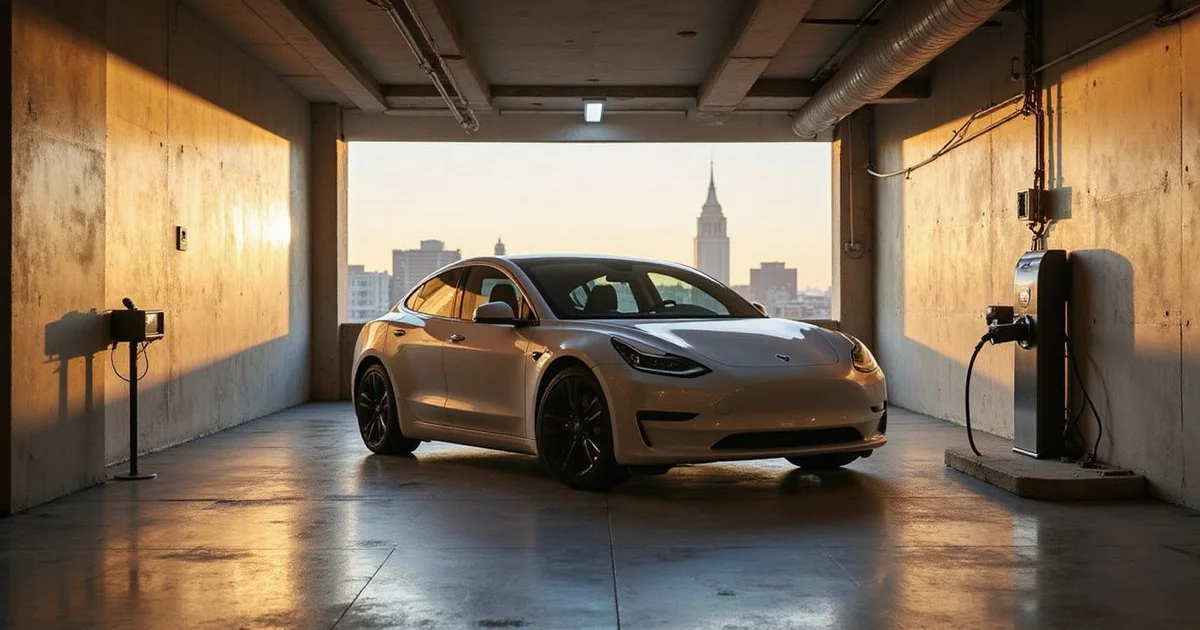
“We Have Chargers” Can Mean a Lot of Things
When clients search for “apartments with EV charging Dallas”, we hear the same frustration every week regarding garage access.
Texas registered over one million electric vehicles by mid-2025, yet many buildings still treat charging as an afterthought. That gap between supply and demand is exactly why a simple “yes” from a leasing agent rarely tells the whole story.
Our team verifies charger access building by building through our high rise apartments with parking search, because the reality on the ground varies drastically. You will find that some properties offer dedicated setups mirroring a home garage, while others force residents into daily battles for a single plug. This guide breaks down the different access models, examines current Dallas electricity rates, and outlines the exact questions you should ask before signing a lease.
How Charger Access Works
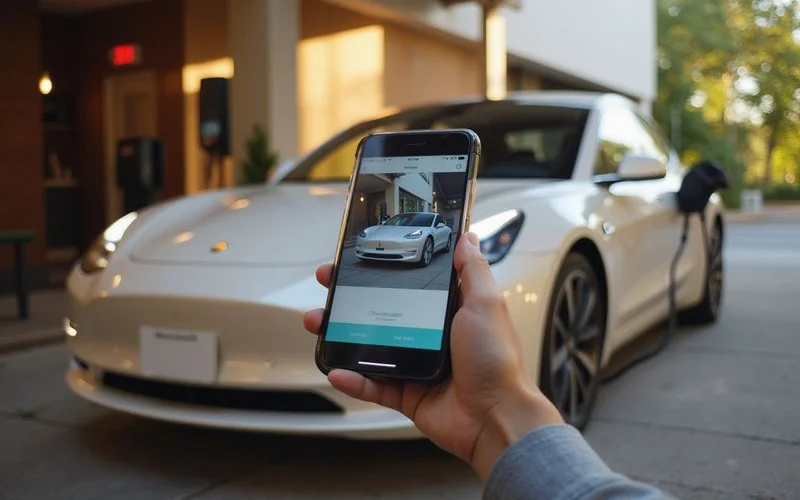
We categorize building charging setups into four main types. The specific model dictates whether you wake up with a full battery or spend your evening moving cars. A single property might even mix these approaches based on the parking level.
Shared chargers
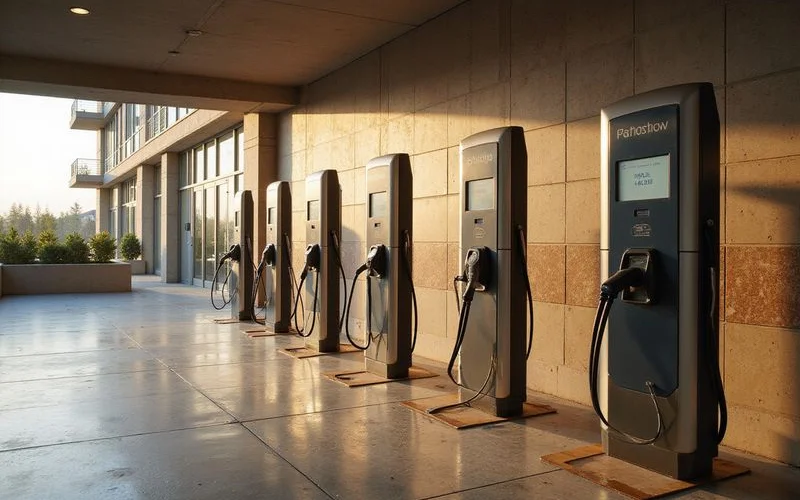
Our team sees Level 2 chargers in common areas operating mostly on a first-come basis. This setup works well if the building has few EV drivers or if you charge during off-hours. Dallas properties frequently use networks like ChargePoint or EV Connect to manage these shared stations.
We always suggest using the PlugShare app to check the real-time reliability of a building’s stations. Broken chargers create instant bottlenecks when demand outpaces supply. Competition for working plugs typically peaks between 6 PM and 10 PM.
Assigned chargers
Our favorite setup involves a dedicated charger tied to your reserved parking space. You pay a monthly fee for exclusive access to this equipment. This represents the closest experience to owning a private residential garage.
We track local electricity rates, and Dallas home charging averages around $0.16 per kWh in 2026. An assigned spot allows you to effectively capture those lower residential rates for your ev charging apartment. The convenience eliminates range anxiety completely for daily commuters.
Waitlists
We frequently encounter long waitlists in older multifamily complexes located in legacy districts like Uptown. Many buildings lack the electrical capacity to support every resident who wants a plug. You need to ask management exactly how many names are on the list.
Our advice is to ask about the historical turnover rate for these spots. A property might have ten chargers for 300 units. That ratio causes severe delays for new tenants trying to secure daily access.
Destination chargers
We occasionally find buildings hosting branded destination chargers instead of generic units. You must verify if these stations use the NACS standard or require a J1772 adapter. Tesla destination chargers are common in newer luxury builds.
Our clients sometimes discover that destination plugs restrict access times. Specific parking rules often govern these premium spaces. A quick chat with the leasing office clears up any compatibility concerns.
Advisor note
Ask how many chargers the building has and how many residents use them. Ten chargers for 300 units is very different from ten for 30 EV owners.
How Charging Is Billed
We analyze charging costs closely because billing methods drastically impact your monthly budget. The financial difference between public station rates and residential rates surprises many new drivers. Public Level 2 stations in Dallas average $0.31 per kWh, while home charging sits near $0.16 per kWh.
| Billing model | How it works | Watch for |
|---|---|---|
| Per kWh | Pay for the energy you use | Rate compared with the $0.16/kWh Dallas home average |
| Per session | Flat fee each time you plug in | Expensive for short top-ups |
| Flat monthly | One fee, unlimited or capped charging | Value depends on how much you drive |
| Bundled in parking | Included with an assigned EV space | Higher base parking fee |
Our cost breakdown shows that flat monthly fees provide great value for heavy drivers. A driver commuting 1,200 miles a month can save over $115 compared to gasoline. Short-distance city drivers usually fare better with a per-kWh model.
We warn drivers to check if the building marks up the electricity rate for a profit. A marked-up per-kWh rate quickly approaches the cost of premium public charging. Transparency in the billing structure is a non-negotiable requirement for any modern garage.
Questions to Ask the Leasing Office
We formulated a specific checklist to uncover the reality of a building’s charging infrastructure. Leasing agents often read from a script that glosses over technical limitations. Asking pointed questions prevents expensive surprises after move-in day.
- How many chargers are available, and are these Level 2 units shared or assigned?
- How is charging billed, and at what rate compared to local utility prices?
- Is there a waitlist, and exactly how many residents are currently in line?
- Are there time limits or idle fees enforced on shared chargers? (Networks like ChargePoint often charge $1 to $5 per hour).
- Which specific app or network do the chargers use?
- Can I legally install my own charger under current property management rules?
We remind Texas residents that the state does not currently have a “Right-to-Charge” law protecting renters. Property code section 81.177 offers some protections for condo owners, but apartment tenants lack guaranteed approval. Landlords possess the legal right to deny personal installation requests.
We therefore rely entirely on the property’s existing infrastructure and management policies. A building’s willingness to accommodate EV drivers speaks volumes about their management style. Clear answers to these six questions will reveal their true commitment to residents.
Charging Plus Parking Type
We view EV access as a critical extension of your complete parking strategy. An assigned charger typically requires signing a lease for a reserved space. This upgrade costs noticeably more than standard unassigned garage access.
Our guide to reserved vs. unassigned vs. valet parking explains the base options in detail. Valet operations sometimes include complimentary charging, but you surrender control of the vehicle. Dedicated reserved parking provides the peace of mind that a plug is always waiting for you.
Charging Scenarios
We match clients to buildings based on their specific daily driving habits. A remote worker requires a completely different setup than a rideshare professional. Mapping your weekly mileage against the building’s infrastructure prevents constant scheduling headaches.
| Driving pattern | What works |
|---|---|
| Short city commutes, a few times a week | Shared chargers, charging once or twice a week |
| Daily commute up the Tollway or I-35E | An assigned charger on a reserved space |
| Two EVs in the household | Two assigned spaces, or one assigned plus shared access |
| Ride-share or delivery driving | Reliable home charging is essential to avoid premium public rates |
| Mostly car-free, occasional trips | Public DC fast chargers may be enough |
We calculate that relying solely on public fast charging costs up to three times more than residential rates. Emergency mobile charging services like Bee Charged EV exist in Dallas, but cost around $165 per session. Finding a reliable level 2 charger apartment setup prevents constant scheduling headaches.
Etiquette on Shared Chargers
We hear countless complaints from residents about poor manners at shared stations. Shared infrastructure functions smoothly only when neighbors adhere to strict community guidelines. Buildings with proactive enforcement usually experience far fewer resident conflicts.
- Move promptly: A fully charged car needs to be moved immediately so others can plug in.
- Respect limits: Time limits exist to ensure everyone gets enough battery capacity for their morning commute.
- Watch for fines: Management often issues tickets or tows non-electric cars parked in designated EV spots.
- Report damage: A broken cord should be reported immediately through the network app to speed up repairs.
Our property tours always check if the leasing office actively patrols these premium spaces. Idle fees automatically billed through the network app serve as a strong deterrent against loitering. Drivers should activate their charging app notifications to track their session progress accurately.
Planning for Future Changes
We track garage infrastructure trends, and the technology upgrades rapidly every single year. A complex with a waitlist today might finalize a major electrical expansion by next spring. The 2026 amenity race pushes developers to aggressively retrofit older concrete garages.
We recommend asking management if current residents receive priority when new stations go live. Utility billing rates also fluctuate based on seasonal ERCOT grid demand. An introductory flat-fee structure could convert to a per-kWh model upon lease renewal.
Our team helps review the fine print to lock in favorable charging terms whenever possible. Smart apartment shoppers secure written guarantees about their EV access rights. Forward-looking properties proudly share their expansion blueprints with prospective tenants.
Combining EV Charging With Other Priorities
We rarely see EV owners looking at charging capability in total isolation. Modern garages, secure access, and premium interior finishes usually top the priority list alongside a plug. Newer towers delivered between 2024 and 2026 incorporate charging infrastructure into their base design.
Our database on the new high rise apartments page highlights these modern buildings. Architects now dedicate substantial electrical panel capacity specifically for high-voltage automotive needs. This integrated planning prevents the blown fuses and power throttling common in retrofitted properties.
We encourage you to tell us your specific vehicle requirements early in the search process. Proper planning puts the most capable, future-proof properties at the top of the shortlist. You secure both a luxury living space and a reliable power source for the car.
If Charging at Home Isn’t Possible
We occasionally find the perfect floorplan in a building that simply cannot support electric vehicles. Some renters accept this compromise and build a routine around external power sources. Dallas offers over 567 public Level 2 ports and 233 DC fast chargers to fill the gap.
We warn clients that relying on public stations turns fueling into a daily logistical chore. A public fast charge averages around $0.49 per kWh, significantly eroding the financial benefits of driving electric. Strategic locations near the North Central Expressway or retail centers make this lifestyle barely manageable.
We will prioritize on-site access during the initial search to save you this ongoing hassle. Charging at work or the grocery store serves as a backup, not a primary strategy. Reach out today, and let us build a customized list of apartments with EV charging Dallas residents love.